
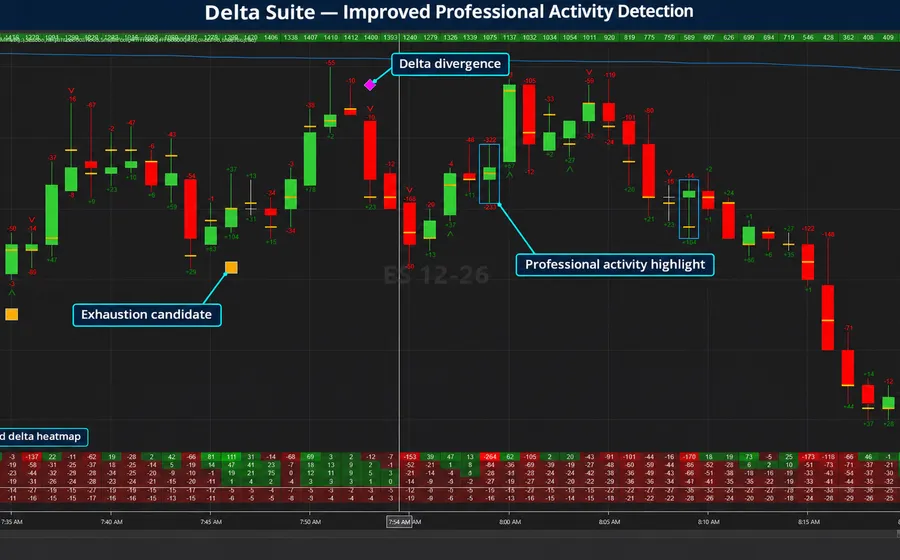
The development problem
An existing NinjaTrader indicator already had a chart layout and settings that users relied on. Extending it with momentum, trade-size context and session cumulative delta created a compatibility problem: how could the new displays agree with each other without replacing the established price-panel behavior?
This example describes Moore Tech’s own Delta Suite integration test. It demonstrates implementation and regression work, rather than a client profitability result or a claim that a signal predicts a reversal.
Preserve the existing contract
The original price indicator retained its name, original factory properties, plot definitions and settings. Existing heatmap, point-of-control and related chart behavior remained the starting point. New lower-panel components were added separately so their scales would not flatten or distort the main display.
Keeping those boundaries explicit made the extension reviewable. Compatibility could be checked against the original source and generated accessors instead of relying on the fact that the new assembly compiled.
Share calculation rules without sharing mutable trading state
The components use shared calculation logic with their own state. Identical input events and settings should produce the same calculated values and signal identities. This avoids a hidden dependency where one panel’s instance owns another panel’s market-data state.
The price component owns price-chart markers, while the momentum component owns its own panel’s markers. Settings checks can flag components configured with different calculation assumptions on the same chart. This does not automatically synchronize the user’s settings.
Make timing and incomplete history visible
Divergence compares defined pivots and becomes available after confirmation. The confirmation bar matters: placing a historical marker on an earlier price extreme must not imply that the signal was available at that earlier time.
Session cumulative delta uses the chart’s Trading Hours session. Partial loaded history is distinguished from a subsequently observed complete session, rather than silently presenting both as equally complete totals.
Those decisions belong in the specification. A request to “add divergence” or “show session delta” leaves the developer to guess at signal timing, resets and missing-history behavior.
What was checked
The local integrated build compiled against the installed NinjaTrader libraries with zero warnings or errors. Its 54 deterministic checks covered flow calculations, pattern rules, session delta and suite behavior.
Suite checks included independent components receiving the same trade stream, matching the preview calculation pipeline, duplicate prevention and session-boundary alignment. Source comparisons checked preservation of the original properties, plots, rendering and accessor behavior.
This evidence concerns the local integration build. Calculation tests and compilation do not replace visual verification in NinjaTrader, settings-persistence checks or simulation/Playback evaluation. They also do not establish trading effectiveness. The source integration test was kept separate from the public release decision.
What this means for a development scope
When extending an existing trading tool, specify what must remain compatible, which component owns each display or action, and when a calculated signal becomes known. Supply testable examples before adding more features.
Use custom trading system development for a build, extension or repair, and the developer hiring checklist to prepare the rules and acceptance examples. The Delta Suite product page provides the current public product and trial information.