
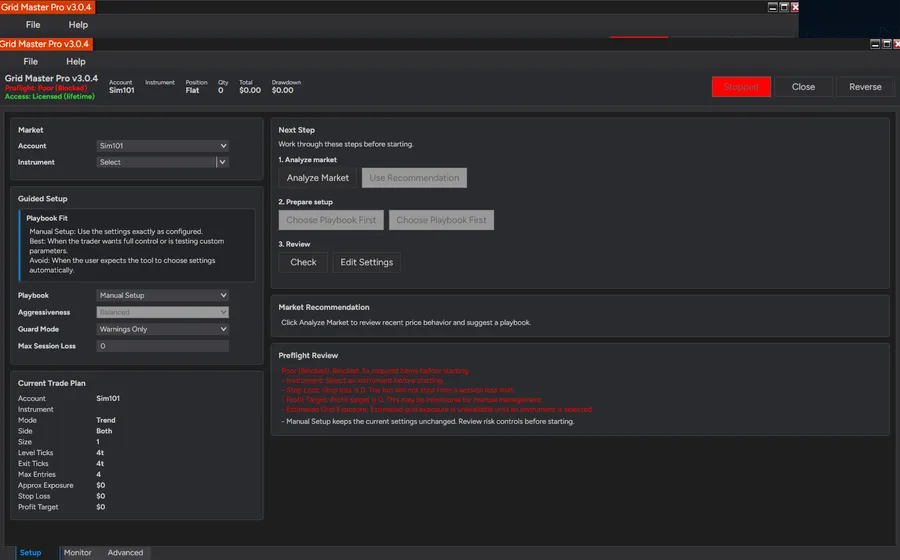
The workflow
Moore Tech needed verified trial signup on one site to connect reliably to access registration, setup email and account downloads on another. A visitor should receive usable instructions without waiting for manual fulfillment, and repeating signup should not create another access record or another setup email.
This is a Moore Tech product-engineering example. It concerns software access and customer operations, not broker order execution or trading returns. No customer identity or credential is needed to explain the design.
The first decision was identifying the authority
The Grid Master client already has a 14-day local simulation trial that starts when its window first opens. Signup does not own that clock. The paid-license authority is a separate system with its own entitlements and expiry rules.
Issuing a new paid-style key at trial signup would have introduced a second access mechanism. The chosen design instead registers trial access, delivers the installer and setup instructions, and preserves the client’s existing trial behavior.
What was built
The verified signup creates a durable delivery job. The receiving service authenticates the request with a dedicated credential and returns a safe registration identifier. It does not expose a paid license key or invent a signup-based expiry.
The integration records an operation before dispatch, preserves the exact email request for retries and keeps a receipt after the email provider accepts it. Repeated signup reuses that registration. Existing paid licenses are left unchanged and routed away from the trial path.
- Verify the account and create one delivery job.
- Register access through an authenticated connection.
- Send setup instructions and preserve the delivery receipt.
- Show the account’s instructions and offer the correct installer.
A failure the local tests did not catch
The first live cross-site test failed before an HTTP response because a request option supported by the local test environment was not supported by the deployed Worker runtime. The delivery job remained pending rather than being marked complete.
The request handling was corrected and a runtime-specific regression test was added. This is why the release included an actual deployed signup flow as well as local unit tests.
Validation and observed outcome
The licensing-side endpoint and existing paid-license behavior passed 63 automated tests. A synthetic production test then simulated losing the stored acknowledgement after the email provider accepted the message. The retry recovered the original provider message ID instead of sending another setup email.
The complete site-to-site test verified sign-in, enrollment, one delivery attempt, the account instructions and the installer checksum. Repeating enrollment reused the registration without a new email request. The provider confirmed delivery to its synthetic test recipient, and the test records were removed.
These checks establish the tested software flow. They do not establish an increase in customer conversion or reduced support costs, which require separate business measurement. Paid subscription lifecycle automation was outside this trial-access scope.
Apply the approach to your integration
The transferable questions are who owns the result, how a duplicate is recognized, and how to recover when the remote action succeeds but its response is lost. Define those before connecting production systems.
Review trading technology integration services or use the integration checklist to prepare your workflow. For architecture decisions before implementation, start with trading technology consulting.