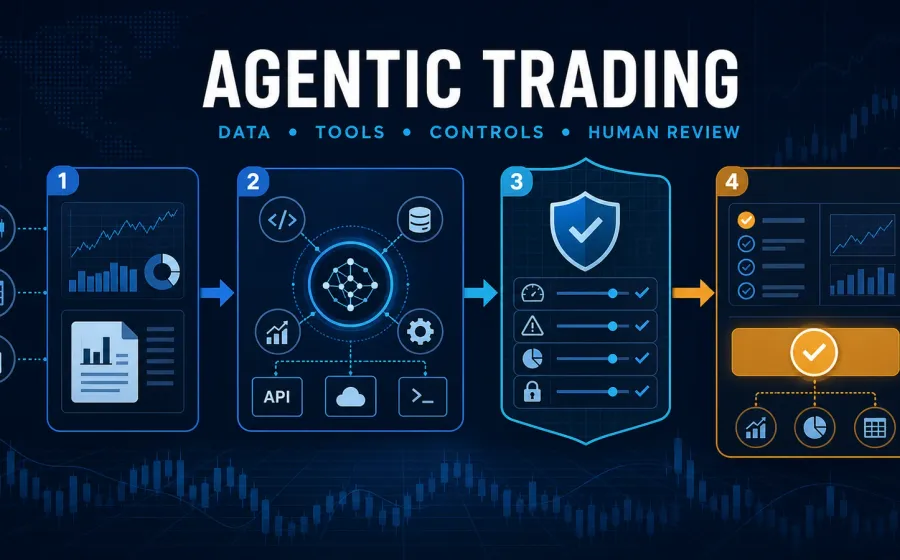
Agentic trading uses an AI agent to observe market or account information, reason about a goal, call approved tools, and take or prepare trading-related actions. Unlike a chatbot that only returns an answer, an agent can continue through a workflow: check data, choose a tool, create an order proposal, request approval, monitor the result, and react to an exception.
That does not mean every agentic trading system should place trades autonomously. A useful first version may be limited to research, monitoring, reporting, alerts, or staged actions that require human approval.
The practical question is not whether software is called an agent. It is what the software can see, what it can do, what stops it, and who is responsible when its assumptions are wrong.
Short definition
Agentic trading is a trading workflow in which an AI agent can interpret context, use approved data and software tools, and complete multiple steps toward a defined objective under explicit permissions and risk controls.
How agentic trading works
Most agentic trading systems can be understood as six connected layers.
| Layer | Job | Example |
|---|---|---|
| Objective | Defines what the agent is trying to accomplish | Monitor an account for exposure outside approved limits |
| Perception | Collects current information | Read positions, quotes, news, strategy state, or broker responses |
| Reasoning | Interprets the information under instructions | Decide whether a limit was breached or more data is needed |
| Tools | Let the agent interact with external systems | Query an API, generate a report, stage an order, or send an alert |
| Controls | Limit what the agent may do | Symbol allowlists, quantity limits, approval gates, and time restrictions |
| Feedback | Shows what happened after an action | Confirm an order state, log an error, or escalate an exception |
A normal workflow might look like this:
- The agent reads approved market, strategy, and account data.
- It checks that the data is current and complete.
- It compares the observed state with the user’s instructions and risk policy.
- It selects an allowed tool, such as a report generator, alert service, or broker API function.
- It prepares an action and requests human approval when required.
- It records the tool response, verifies the resulting state, and stops or escalates if the result is unexpected.
The feedback step is important. Software that produces a recommendation but never verifies what happened is an AI assistant, not a complete closed-loop trading agent.
Agentic trading vs algorithmic trading
Algorithmic trading and agentic trading can work together, but they solve different problems.
An algorithmic strategy usually follows predetermined entry, exit, sizing, and order-handling rules. If condition A occurs, the program performs action B. The behavior should be repeatable for the same inputs.
An agentic workflow coordinates a broader sequence. It may decide which data to inspect, which approved tool to call, whether the situation matches a known exception, and when to ask a human for help. The reasoning layer may be probabilistic even when the final execution and risk controls are deterministic.
| Question | Algorithmic trading | Agentic trading |
|---|---|---|
| Primary job | Execute defined trading rules | Coordinate data, tools, decisions, and exceptions |
| Typical input | Prices, indicators, account state | Structured data plus text, reports, logs, and tool responses |
| Typical output | Signal, order, or position update | Report, alert, proposed action, tool call, or escalation |
| Best control model | Deterministic strategy and order rules | Permission boundaries plus deterministic safety checks |
| Main failure risk | Bad rules, overfitting, or order-state errors | Bad context, unsafe tool use, vague instructions, or false confidence |
Read the full agentic trading vs algorithmic trading comparison when deciding which architecture fits a project.
Agentic trading vs a trading bot, robo-advisor, and AI assistant
The labels overlap, so it helps to separate them by behavior.
Trading bot
A conventional trading bot follows coded rules. A grid bot, breakout strategy, or moving-average system does not become agentic merely because it is automated. If a fixed rule can solve the problem reliably, the bot is usually easier to test, audit, and support.
Robo-advisor
A robo-advisor generally places investors into a managed allocation process based on a questionnaire, portfolio model, and rebalancing policy. It is a financial product and service model, not simply an AI agent connected to user-selected tools.
AI trading assistant
An assistant analyzes information or answers questions but stops before taking action. It may explain a chart, summarize news, or draft a trading plan. It becomes more agentic when it can choose and call tools, maintain workflow state, verify outcomes, and continue without a separate prompt for every step.
Agentic trading system
An agentic system links reasoning to controlled action. The action does not have to be an order. Generating a daily report, reconciling strategy state, monitoring several APIs, or escalating a rejected order can all be agentic workflows.
Real-world agentic trading examples in 2026
The term moved from research into brokerage and exchange products during 2026.
Robinhood’s Agentic Trading documentation describes connecting a third-party AI agent to its Trading MCP, or Model Context Protocol. The connected agent can read account information and place orders in a dedicated Agentic account. Robinhood also states that users remain responsible for the agent’s trades and warns that agents can misunderstand instructions, use incomplete information, and behave unexpectedly.
Gemini introduced Agentic Trading through MCP access to its exchange API. Its published examples include tools for market data, spreads, candles, and order actions that an AI agent can call as part of a workflow.
These products illustrate three architectural ideas:
- The language model is not the brokerage or exchange.
- A protocol or API exposes specific tools the agent may call.
- The account, API permissions, and platform controls remain part of the risk boundary.
Agentic trading can also be built around established platforms. For example, an agent might monitor NinjaTrader strategy state and logs while deterministic NinjaScript handles entries and exits. An Interactive Brokers workflow might use an agent for research and exception handling while a separate service enforces account, symbol, and order limits.
What agentic trading is good at
Agentic workflows are most useful when a task involves several systems, unstructured information, or repeated decisions about which step comes next.
Good early use cases include:
- Monitoring strategy, connection, account, and market states across systems.
- Creating pre-market, intraday, or post-session reports from approved sources.
- Comparing current exposure with a written risk policy.
- Summarizing research while preserving links to the underlying evidence.
- Detecting missing data, rejected orders, state mismatches, and other exceptions.
- Preparing a reviewable order ticket without submitting it.
- Routing an issue to a trader or operator with the relevant context attached.
- Coordinating a defined workflow across files, databases, alerts, and APIs.
These jobs can save time without asking an AI model to invent a trading edge or control an account without supervision.
What agentic trading is not proven to do
Agentic does not mean profitable, safe, or self-correcting.
A 2026 research review, Agentic Trading: When LLM Agents Meet Financial Markets, evaluated 77 studies and found major gaps in comparable testing, transaction-cost modeling, execution semantics, and reproducibility. Only a smaller subset satisfied the review’s minimum definition of producing actions and evaluating them in a closed loop.
That matters because a promising backtest or simulation may omit:
- Commissions, spreads, slippage, and market impact.
- The delay between observing information and executing an order.
- Survivorship and look-ahead bias.
- Partial fills, rejected orders, and disconnects.
- Changing market regimes.
- Model, prompt, data-source, or tool-version changes.
An agent can produce a persuasive explanation for a weak decision. Natural-language confidence is not evidence of trading performance.
The main risks
Incorrect or stale context
The agent may reason correctly from information that is delayed, incomplete, mapped to the wrong symbol, or taken from the wrong account. Every important input needs a timestamp, source, and validation rule.
Instruction ambiguity
Natural-language requests often omit quantity, order type, time horizon, session, account, or failure behavior. Those omissions should cause a clarification or stop, not an improvised trade.
Tool and permission misuse
An agent with broad API access can call the right function with the wrong parameters or call a function at the wrong time. Tools should use narrow schemas, approved values, and server-side validation that the model cannot override.
Hallucinated facts or rationale
Language models can generate unsupported claims, incorrect calculations, or explanations that sound more certain than the evidence. Calculations and account checks should be performed by deterministic code whenever possible.
Prompt injection and untrusted content
News, web pages, emails, and documents are data, not instructions. A trading agent that reads external content must prevent that content from changing its permissions or directing tool use.
Operational speed
An agent may continue acting faster than a person can review the consequences. Rate limits, order limits, kill switches, and alerting must exist outside the model.
Marketing and compliance risk
Claims about AI capabilities should describe what the system actually does. The SEC has taken action over misleading AI claims, reinforcing the need to avoid vague claims about predictive power or automated returns.
Controls to require before live use
At minimum, define:
- Read permissions: exact accounts, data sources, files, tables, and fields.
- Write permissions: exact tools and actions, with everything else blocked.
- Trading limits: accounts, symbols, quantity, notional value, order count, and session.
- Approval gates: actions that always require a person to approve or reject them.
- Data validation: freshness, completeness, symbol mapping, and market-session checks.
- Failure behavior: what happens after timeouts, partial data, rejections, or conflicting state.
- Audit logs: inputs, reasoning summary, tool calls, responses, approvals, and resulting state.
- Kill switch: a deterministic way to revoke access and stop new actions.
- Staged rollout: read-only monitoring before recommendations, approvals, or limited automation.
The safest architecture keeps probabilistic reasoning separate from deterministic limits. The model can suggest or coordinate; code outside the model enforces what is allowed.
Use the agentic trading risk-controls guide and software scope checklist to turn these controls into testable requirements.
A practical first-version roadmap
For most teams, the first version should move through four stages.
- Observe: Give the agent read-only access to approved data and evaluate its reports against known examples.
- Recommend: Let it prepare alerts or actions, but require a person to act separately.
- Stage: Allow the agent to create a reviewable action through a narrow tool, with approval required before submission.
- Automate selectively: Remove an approval only for a tightly bounded action that has passed testing and can be stopped independently.
If stage one is not reliable, adding order access will not make it reliable.
Should you use agentic trading?
Agentic trading may fit when the workflow genuinely needs context from several sources, tool coordination, exception handling, or human-review routing.
A conventional algorithm or script is usually the better choice when:
- The trading rule is already deterministic.
- Low latency and repeatability matter more than flexible reasoning.
- Inputs and outputs fit a stable schema.
- The same conditions should always produce the same action.
- The workflow can be tested completely without a language model.
Use an agent where flexible coordination adds value. Keep rule execution, account limits, and safety-critical checks deterministic whenever possible.
Frequently asked questions
Can an AI agent trade automatically?
Yes, when a brokerage, exchange, or custom integration exposes an order tool and the account grants the required permission. Whether it should trade without approval is a separate risk decision. Start with a dedicated test environment or narrowly bounded account and explicit limits.
Is agentic trading the same as AI trading?
Agentic trading is one type of AI trading. AI trading can also refer to predictive models, sentiment analysis, machine-learning signals, or assistants that never take action. “Agentic” emphasizes multi-step decisions and tool use.
Does agentic trading guarantee better returns?
No. Agentic architecture changes how software observes, decides, and acts; it does not establish that the underlying strategy has an edge. Performance still depends on data, strategy quality, costs, execution, testing, and market conditions.
Does an agent need direct broker access?
No. Many valuable agents are read-only. They monitor, summarize, reconcile, prepare, and escalate while a person or deterministic system handles execution.
What is MCP in agentic trading?
Model Context Protocol is a standard way for an AI application to discover and call external tools. In trading, an MCP server might expose market-data, account, reporting, or order functions. MCP provides the connection pattern; the tool design and permissions determine what the agent can actually do.
Next step
If you are still deciding between an agent and a conventional strategy, use the agentic vs algorithmic trading guide. If the project needs a supervised agent across platforms, data, and APIs, review Moore Tech’s agentic trading software development service.
Planning an agentic workflow?
Define the tools, permissions, review gates, and failure behavior before development starts.
Send the platform, broker or API path, data sources, proposed agent role, blocked actions, and example workflows. Moore Tech can help turn them into a controlled software scope.
This article is educational and does not provide investment, financial, legal, or trading advice. Trading involves risk, including loss of principal.