An ES day trading strategy can be built from price action alone, but many traders also watch market internals to understand whether the broader equity market is supporting or contradicting the move.
Market internals do not remove risk, and they do not make a strategy predictive by themselves. They can, however, provide useful context when the strategy is designed and tested around specific inputs.
What market internals add to ES review
ES futures track the S&P 500, so broader equity-market participation can matter. A move in ES may look strong on the chart while breadth, volume participation, or volatility context tells a more cautious story.
Common internals and breadth inputs include:
- VIX for volatility context.
- TICK for short-term NYSE buying or selling pressure.
- TRIN for breadth and volume relationship.
- ADD and ADV/DECL for advancing versus declining participation.
- UVOL/DVOL for up-volume versus down-volume pressure.
- Nasdaq volume breadth for technology-heavy participation context.
The point is not to watch every number manually. The point is to define which conditions matter, how they are measured, and how they affect the trade decision.
Price still has to be part of the system
Market internals are context. They are not a complete trade plan on their own.
A practical ES day trading strategy still needs clear price behavior:
- Where entries are allowed.
- What invalidates a setup.
- How position size is controlled.
- How exits are handled.
- Whether the strategy can re-enter.
- When the strategy must stop trading for the day.
If the strategy is automated in NinjaTrader, those rules need to be precise enough for NinjaScript to evaluate consistently.
Why intraday exits matter
Day trading systems should be explicit about overnight exposure. Holding ES overnight introduces a different risk profile, different liquidity conditions, and different margin considerations than an intraday workflow.
If a strategy is intended for day trading, confirm whether it includes flattening logic, time-based exits, or session controls. Also test what happens around holidays, early closes, contract roll periods, and platform reloads.
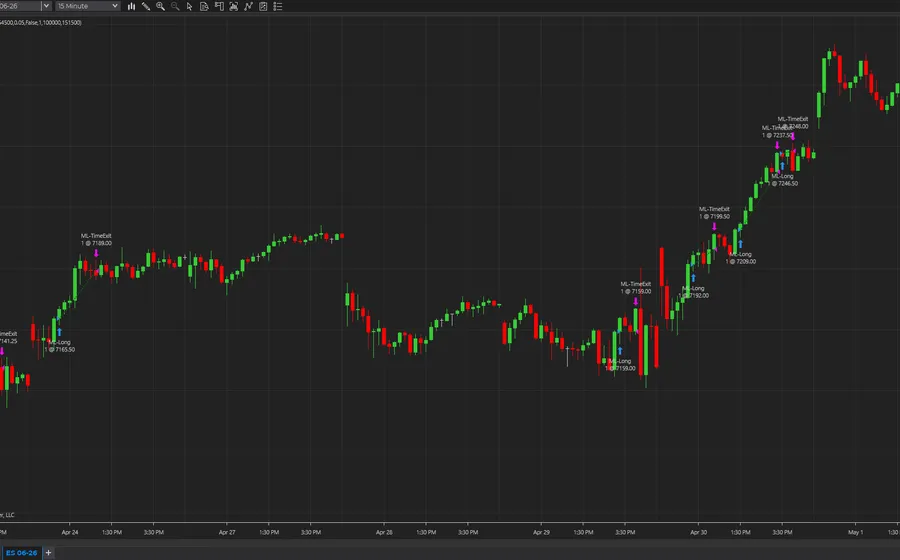
Market Pulse AI is one example of a NinjaTrader 8 ES futures strategy built around machine-learned market internals and breadth behavior. It is positioned for long-side intraday opportunities and is designed with no overnight holding logic.
Data provider checks come first
Market internals are only useful if the platform can access the correct data. Symbol names and availability can vary by provider, and some feeds require additional subscriptions.
Before buying or building an ES strategy that depends on internals, confirm:
- Which exact internals are required.
- How those symbols are named by your data provider.
- Whether historical data is available for each series.
- Whether the strategy requires secondary data series to load before trading.
- Whether missing data blocks trading or creates fallback behavior.
This is especially important for systems that use VIX, TICK, TRIN, ADD, ADV/DECL, UVOL/DVOL, or Nasdaq breadth data.
Backtest results need context
Backtests can be useful for research, but ES strategy performance depends heavily on assumptions. Date range, contract handling, commissions, slippage, fill logic, session template, and data quality can all affect the result.
When reviewing any day trading strategy page, look for clear language explaining whether results are live, simulated, or hypothetical. Performance screenshots should be labeled accordingly, and profit numbers should not be separated from the disclosure.
Build or buy
Buying a product makes sense when the existing strategy matches the market, data, and workflow you want to evaluate. A custom build makes sense when your rules, internals, exits, risk model, or reporting needs are different.
Useful next steps:
- Market Pulse AI market internals strategy for ES futures
- The Moore Tech Morning Brief for daily ES/NQ, macro, sentiment, intermarket, and price-confirmation context before the U.S. session.
- Futures trading bot for NinjaTrader: build, buy, and test
- NinjaTrader automated trading guide
- NinjaTrader programmer services
Risk note
Market internals can support strategy research, but they do not eliminate trading risk. Futures trading involves substantial risk and is not suitable for all investors. Trading software is not financial advice, and historical or simulated results do not represent live trading.