
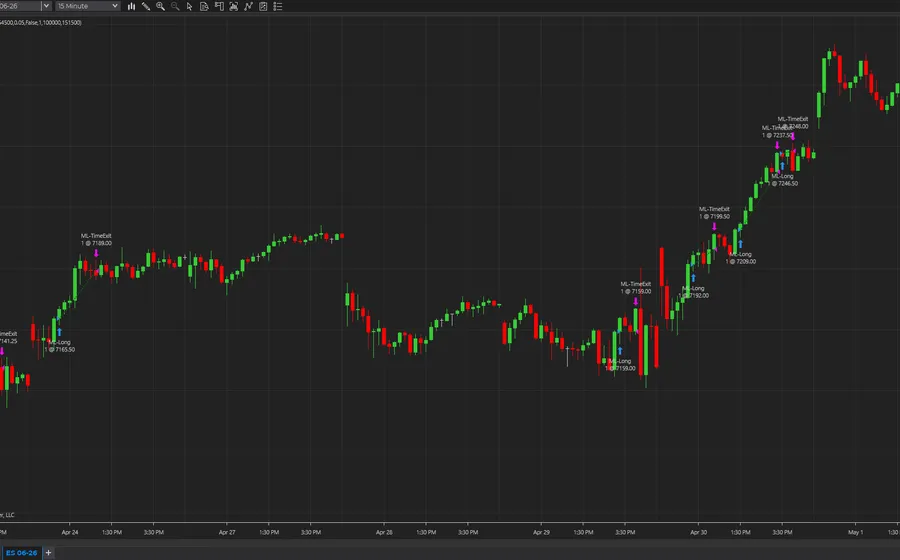
The ES open is noisy. Overnight inventory gets repriced, economic headlines get digested, cash-session orders hit the tape, and traders who were right at 8:45 can still be badly positioned by 9:45.
Market internals help because they show whether the broader equity market is participating in the move. They do not tell you where ES must go next. They do not turn a weak trade plan into a strong one. Used well, they give you a cleaner read on whether the morning move has pressure behind it, whether it is narrow, and whether you should wait for price to confirm instead of forcing a trade.
This is a practical way to review internals before the U.S. cash open.
Start with the job of each internal
Do not treat every internal as a buy or sell signal. Each one answers a different question.
- VIX gives volatility context. Rising VIX into the open usually means risk conditions are different from a quiet grind-up session.
- TICK shows short-term NYSE buying or selling pressure. It is useful for bursts of participation, not for a complete session bias by itself.
- TRIN compares advancing and declining volume pressure. It can help separate broad participation from a move carried by a smaller group of stocks.
- ADD or ADV/DECL shows advancing issues versus declining issues. It is a breadth read, not an execution trigger.
- UVOL/DVOL compares up-volume to down-volume. It helps show whether volume is actually supporting the direction.
- Nasdaq breadth can matter when technology leadership is driving or fighting the ES move.
That is already a lot. The goal is not to stare at six panels and react to every flicker. The goal is to build a short premarket note: volatility, breadth, volume pressure, leadership, and price confirmation.
Build the premarket note before looking for trades
Write the note before the open, not after the first move tempts you into a story. A useful note can be simple:
- Overnight ES direction.
- Prior day high, low, close, and value area if you use one.
- Major premarket economic events or Fed-related calendar risk.
- VIX direction compared with the prior close.
- Breadth expectation: likely broad, mixed, or narrow.
- First price areas that would confirm or reject the bias.
The last line matters most. If you cannot name the price behavior that would prove your read wrong, you do not have a usable bias. You have an opinion.
For example, a bullish note might say:
- ES held above the overnight midpoint.
- VIX is soft.
- Nasdaq breadth is supportive.
- I want to see ES hold above the prior close and accept above the overnight high before treating pullbacks as long-side candidates.
That is more useful than “internals look bullish.” It gives you a condition to wait for.
Watch price and internals together
Internals are most useful when compared with ES behavior. The important question is not whether TICK is green or red. The question is whether the internals agree with what price is trying to do.
Three common situations are worth separating:
- Price breaks higher and internals expand with it.
- Price breaks higher while breadth and volume stay flat or mixed.
- Price fails near a known level while internals deteriorate.
The first case may support continuation research. The second case argues for patience because the move may be narrow or headline-driven. The third case can warn that a long setup needs more confirmation or should be skipped.
None of this means you should short every divergence or buy every breadth expansion. It means your trade plan should care whether the broader market is helping or fighting the ES chart.
Use a sequence, not a pile of indicators
A good premarket workflow has an order. Here is a simple one:
- Mark the ES structure first: overnight high and low, prior session high and low, prior close, and any obvious gap.
- Check the volatility backdrop: VIX direction and whether the session is likely to be jumpy.
- Check breadth: ADD, ADV/DECL, or another advancing-versus-declining measure.
- Check volume pressure: UVOL/DVOL or a similar up-volume/down-volume read.
- Check leadership: whether Nasdaq breadth is confirming or fighting the ES move.
- Define the first confirmation level and the first invalidation level.
This order keeps you from using internals as decoration. Price defines the battlefield. Internals tell you whether participation is lining up with the move.
Be careful with the first 15 minutes
The cash open can produce extreme readings that look meaningful but are really just opening imbalance, news digestion, or short-term order flow. TICK spikes, breadth flips, and ES can travel several handles before the real session tone settles.
For many traders, the better habit is to use the first 5 to 15 minutes to test the premarket note:
- Did ES accept above or below the overnight range?
- Did breadth expand or fade after the initial open?
- Did volume pressure confirm the direction?
- Did VIX keep moving with the risk tone, or did it reverse?
- Did Nasdaq leadership support ES, or did it create a split tape?
If the open answers those questions clearly, you have a better read. If it does not, doing nothing is still a decision.
Know when internals are mixed
Mixed internals are not a problem. They are information.
A mixed tape can look like this:
- ES is pushing up, but VIX is not softening.
- TICK is positive, but ADD is only slightly above flat.
- Nasdaq breadth is strong, but NYSE breadth is mediocre.
- UVOL/DVOL supports buyers early, then fades while price keeps grinding.
That kind of morning may still produce trades, but it is not the same as a broad, clean participation day. If your strategy depends on trend follow-through, mixed internals may call for smaller expectations, tighter validation, or simply waiting for a cleaner setup.
This is where traders get into trouble with automated logic. They convert one internal into a yes/no gate and ignore the rest of the context. A better system design usually separates regime, setup, confirmation, execution, and risk.
Check the data before trusting the read
Market internals are only useful if your platform is receiving the right symbols at the right time. This matters in NinjaTrader because symbol names and data availability can vary by provider.
Before relying on a market-internals workflow, confirm:
- The exact VIX, TICK, TRIN, ADD, ADV/DECL, UVOL/DVOL, and Nasdaq breadth symbols your provider supports.
- Whether the symbols have real-time and historical data.
- Whether the data loads consistently before the cash open.
- Whether holidays, half days, and session templates affect the series.
- Whether missing secondary data should block trading, warn you, or fall back to a simpler mode.
If you are using an automated NinjaTrader strategy, do not treat missing secondary data as a small issue. It can change the strategy’s behavior completely.
Turn the read into a decision tree
The easiest way to make market internals useful is to write a small decision tree.
Example:
- If ES is above the overnight high, breadth is expanding, and VIX is soft, I will consider long-side pullbacks after confirmation.
- If ES is above the overnight high but breadth is mixed, I will wait for acceptance and avoid chasing the first breakout.
- If ES is below the prior close, VIX is firm, and down-volume is expanding, I will not take long-side continuation setups without a clear reversal.
- If internals are split, I will reduce expectations and let price define the next trade.
That kind of checklist is plain, but it is much easier to test than a vague read like “market internals look good.”
How this connects to automation
If you want to automate an ES strategy around market internals, the question is not “Can NinjaTrader read these inputs?” The better question is “What role does each input play?”
Decide whether each internal is used for:
- Session regime.
- Trade direction filter.
- Entry confirmation.
- Trade avoidance.
- Position sizing.
- Exit logic.
- Daily stop or pause conditions.
Those are different jobs. Mixing them together creates brittle systems. A clean NinjaScript build should make the logic explicit, log the reasons a trade was allowed or blocked, and handle missing data safely.
Market Pulse AI is one productized example of an ES-focused NinjaTrader strategy that uses price action with market internals and breadth behavior. It is built for intraday ES context, not overnight holding. If your workflow is different, use that distinction as a scoping tool rather than trying to bend a product into a strategy it was not designed to be.
A simple pre-open checklist
Use this before the cash session:
- What did ES do overnight?
- Where are prior high, prior low, prior close, overnight high, and overnight low?
- Is VIX supporting risk-on behavior, risk-off behavior, or uncertainty?
- Are breadth and volume pressure broad, mixed, or narrow?
- Is Nasdaq leadership confirming or diverging from ES?
- What price level confirms the bias?
- What price behavior invalidates the bias?
- What should I avoid if the first 15 minutes are noisy?
- Does my data provider have every internal required for the workflow?
- Is this a day for automation, manual discretion, or no trade?
The best version of this checklist is short enough that you will actually use it. Long premarket rituals tend to become hindsight machines.
Useful next steps
If you want a daily structured read instead of rebuilding the process from scratch each morning, The Moore Tech Morning Brief is built around ES/NQ narrative context, macro risk, sentiment, intermarket confirmation, and price-confirmation notes.
If you are evaluating a productized ES strategy, review Market Pulse AI and confirm that your data feed supports the required market internals. If your rules, filters, risk model, or execution behavior are different, start with NinjaTrader programmer services so the strategy can be scoped around your actual workflow.
Related reading:
- ES day trading strategy using market internals
- How to evaluate brokers and data feeds for automated futures trading
- Futures trading bot for NinjaTrader: build, buy, and test
- NinjaTrader backtest vs live results
Risk note
Market internals are context, not financial advice. Futures trading involves substantial risk and is not suitable for all investors. Backtested, simulated, or hypothetical examples do not represent live trading results, and no market-internals checklist can guarantee an outcome.